
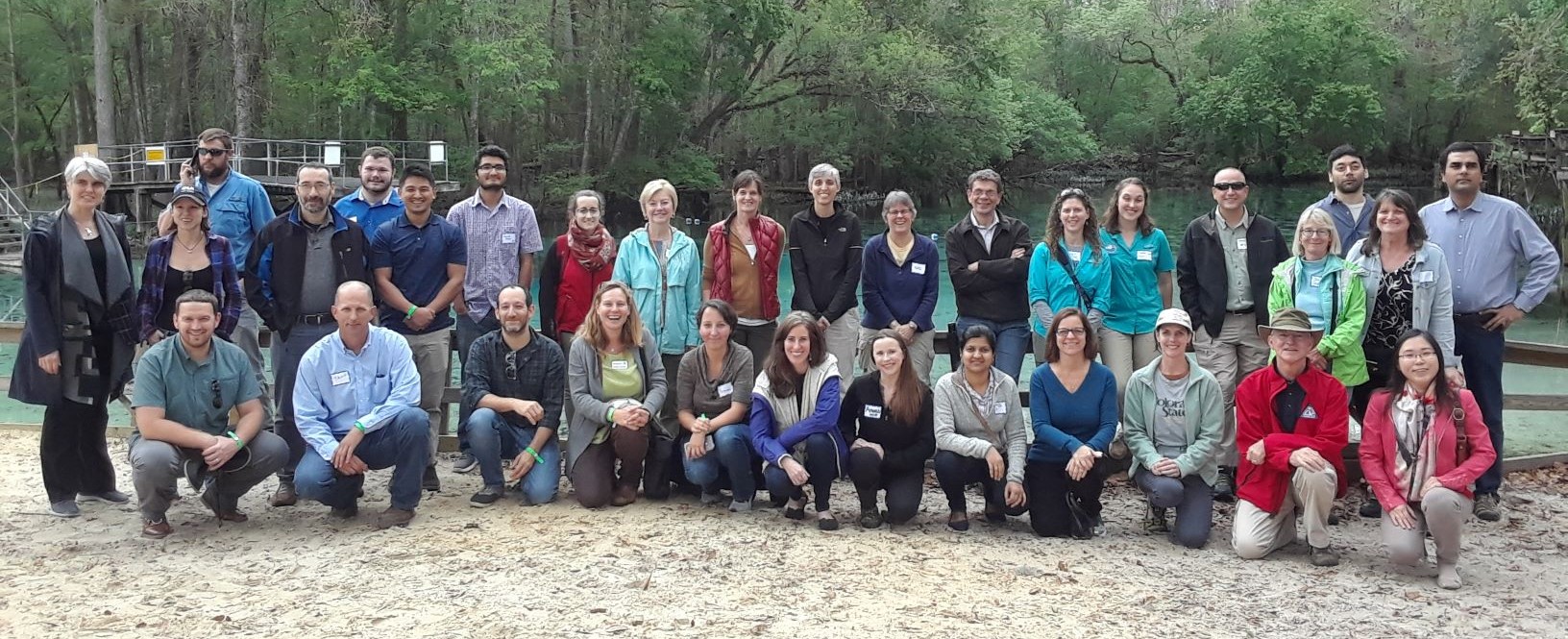
Who we are
X number of researchers, facilitators, and students from the University of Florida, the University of Georgia, Albany State University, and Auburn University collaborated on the FACETS project.
A Project Advisory Committee, comprised of key representatives from agricultural, environmental, regulatory and scientific organizations in the region, helped define expectations for, and evaluate quality of, outcomes and impacts of research, education, and Extension activities throughout the project.
Stakeholders from diverse sectors participated in the Participatory Modeling Process and assisted in model development and collaboratively interpreted the outputs.
Goals and thrust areas
The overarching goal of the FACETS project is to provide information for guiding management and policy decision that support economic sustainability of agriculture and silviculture in N Florida and S Georgia while protecting water quantity, quality, and habitat in the UFA and the springs and rivers it feeds.
The project was organized around five main thrust areas:
BMP research: Conduct Best Management Practice field research to demonstrate promising new cropping systems and BMPs that had not been previously demonstrated or widely adopted by stakeholders in the region.
Modeling: Build a comprehensive modeling platform to predict farm/forest- and regional-scale impacts of alternative land use and production practices on the water quantity, water quality, and economy of North Florida and South Georgia.
Stakeholder Engagement: Integrate stakeholders’ experience with scientific data and models to explore economic-environmental tradeoffs among current and potential future climate, land use, Best Management Practice (BMP) adoption and policy scenarios to understand changes needed to achieve agricultural water security and environmental protection.
Stakeholder Valuation Research: Understand stakeholders’ perceptions of financial incentives to help meet water standards including landowners’ and producers Willingness to Accept (WTA) and general public’s Willingness to Pay (WTP) for BMP adoption.
Communications Research: Explore how different stakeholders think about and perceive information about water quality and quantity in Georgia and Florida and provide recommendations to increase the productivity of water conversations between and within stakeholder groups.
Extension Programming: Develop and deliver innovative Extension BMP demonstrations, digital decision toolkits and training programs for diverse stakeholders to bring about preferred changes in production systems and incentive programs
Thrust Areas Overview
